Introduction
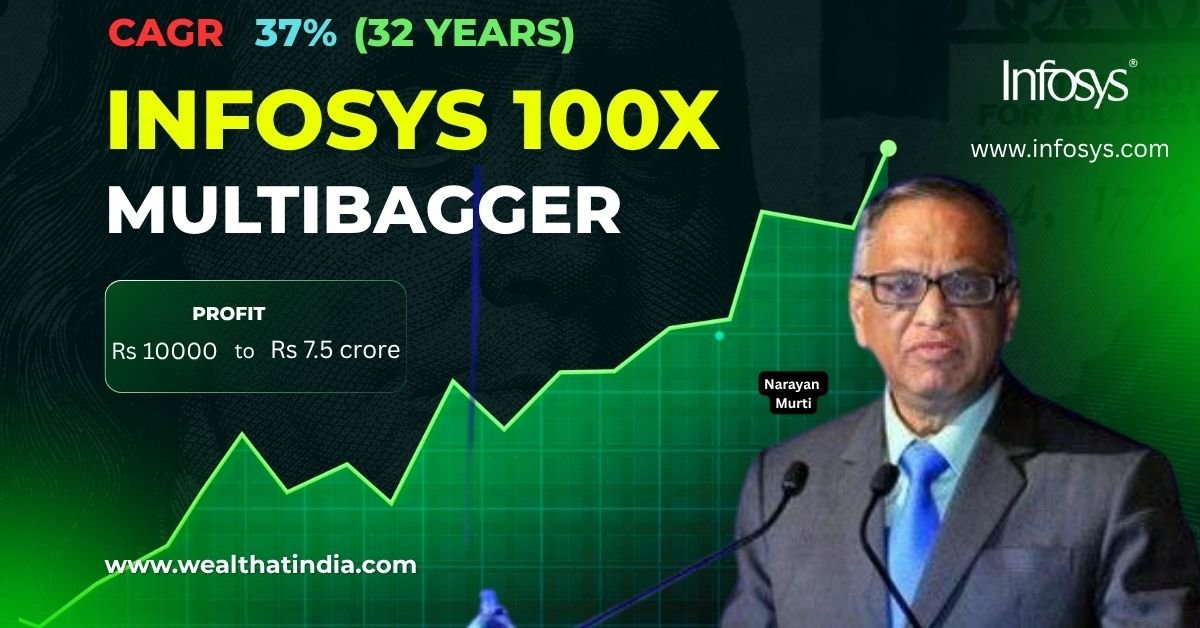
Every great stock market success story begins with a vision one that combines belief, innovation, and perseverance. When investors talk about long-term wealth creation in India, the Infosys Success Story in India often stands as the gold standard. What began in 1981 as a small company founded with just ₹10,000 has grown into one of the world’s largest IT service providers, valued at over ₹6 lakh crore today.
The Infosys Success Story in India is not just about building a company; it represents the nation’s transformation from a developing economy to a global technology hub. For long-term investors, Infosys has been the ultimate multibagger turning small investments into life-changing wealth. But this success didn’t happen overnight. It was the result of vision, discipline, corporate governance, and relentless innovation.
Let’s dive deep into the fascinating journey of how Infosys became a 100x multibagger and uncover the key lessons investors can learn from its story.
The Humble Beginning: A ₹10,000 Dream in 1981
Infosys was founded in 1981 in Pune by Narayan Murthy and six co-founders Nandan Nilekani, S. Gopalakrishnan (Kris), S.D. Shibulal, K. Dinesh, Ashok Arora, and N.S. Raghavan. The total initial investment? Just ₹10,000 borrowed from Sudha Murthy, Narayan Murthy’s wife.
At that time, India had minimal computing infrastructure, almost no internet, and extremely restrictive policies for IT exports. But Murthy and his team had an unshakable belief: that software would shape the future, and India had the brainpower to serve global clients.
Their first office was a small apartment. They coded software, trained themselves, and slowly began to attract small foreign clients. It was not easy. The team often faced delays, lack of capital, and even bureaucratic challenges including months long waits for computer imports.
Still, they persisted. Murthy’s leadership philosophy was simple: “Powered by intellect, driven by values.” This foundation became Infosys’s greatest long-term strength.
The Struggle Years: 1980s – Building Credibility Brick by Brick
During the 1980s, the Indian IT sector was in its infancy. There was no Silicon Valley glamour, no startup ecosystem, and no venture funding. Many companies shut down before they could even start. Infosys survived because it built its foundation on discipline, transparency, and client satisfaction.
The company began to secure projects from American clients, helping them with software development and systems maintenance. Each contract strengthened Infosys’s reputation for quality and reliability. The founders worked endless hours, often coding through nights and managing teams during the day.
At one point, the co-founders almost sold the company due to mounting challenges. But Murthy famously refused to give up. He motivated the team to hold on and that decision changed history.
By the end of the 1980s, Infosys had carved a niche as a trusted Indian IT partner a rare achievement at that time.
The Big Break: 1993 – Infosys Goes Public
The 1990s were transformative for India and Infosys. In 1991, India’s economic liberalization opened doors for private businesses and technology exports. Infosys was perfectly positioned to capitalize on these reforms.
In 1993, Infosys launched its Initial Public Offering (IPO) at just ₹95 per share. However, investors weren’t convinced. The issue was undersubscribed, and global investment bank Morgan Stanley had to underwrite it to ensure success.
No one at that time could have imagined what was coming next.
The same ₹95 share, after several bonus issues, stock splits, and dividends, has grown to over ₹1 lakh in value today. A mere ₹10,000 invested during the IPO is now worth over ₹1 crore even without counting dividends.
This IPO marked the start of Infosys’s journey from a small Indian company to a global blue-chip brand.
Riding the Y2K and IT Boom: 1995 to 2000
The mid-1990s brought a revolution in global IT and Infosys was ready. As the world prepared for the Y2K problem, where computer systems risked malfunctioning in the year 2000, companies sought reliable partners to fix their code.
Infosys, with its skilled engineers, disciplined management, and cost-efficient delivery, became a preferred choice for American and European corporations.
Between 1995 and 2000, Infosys’s revenue skyrocketed from $20 million to $200 million. In 1999, Infosys became the first Indian company to be listed on the NASDAQ a defining moment that placed India’s IT sector on the global map.
By 2000, Infosys had achieved what no one thought possible: global recognition as a world-class software services company. Investors who held the stock during this period saw astronomical gains.
The 2000s: Surviving the Dot-Com Crash and Building Global Scale
The early 2000s were turbulent. The dot-com crash wiped out technology stocks worldwide. Many startups failed, and investor sentiment turned negative. But Infosys stood tall.
Unlike speculative internet firms, Infosys had real clients, robust contracts, and a solid reputation. It emerged from the crash stronger, not weaker.
This decade saw Infosys expand its footprint across North America, Europe, and Asia. It built large development centers, implemented process excellence through CMM Level 5 certifications, and launched its flagship business platform Infosys Finacle which became one of the world’s leading banking software products.
Infosys also pioneered the Global Delivery Model (GDM) a concept where work is divided between on-site client locations and offshore Indian centers to optimize cost and quality. This model revolutionized outsourcing and was later adopted across the entire IT industry.
The Leadership Edge: Building Trust and Transparency
Infosys’s leadership has always been one of its strongest pillars. The company was founded on ethics, integrity, and fairness values that distinguished it from many peers.
Narayan Murthy’s leadership focused on humility, employee empowerment, and transparent corporate governance. He often reminded his team that “respect and trust” are more valuable than short-term profits.
Nandan Nilekani, who later became CEO and also headed Aadhaar’s development for the Indian government, brought visionary leadership and futuristic thinking. Under his guidance, Infosys expanded into consulting and product engineering.
The company was also among the first in India to introduce Employee Stock Options (ESOPs), allowing employees to share in the company’s wealth. Many early employees became millionaires, creating a loyal and motivated workforce.
Infosys’s commitment to corporate governance and clean accounting made it a favorite among global institutional investors, earning it the reputation of “India’s most transparent company.”
2010s: Adapting to the Digital Era
As the world entered the digital age, Infosys faced new challenges. The rise of cloud computing, artificial intelligence (AI), automation, and data analytics meant that traditional outsourcing was no longer enough.
Infosys responded by transforming itself under new leadership. Vishal Sikka, appointed CEO in 2014, introduced a shift toward AI-based solutions and automation. Later, under Salil Parekh, Infosys deepened its focus on digital transformation, strategic consulting, and cloud integration.
By continuously innovating and reskilling its employees, Infosys ensured its relevance in a rapidly changing global tech landscape.
Today, digital services contribute to over 60% of Infosys’s revenue, proving the company’s adaptability and forward-thinking approach.
Stock Market Journey: From ₹95 to Over ₹1,500
Infosys’s stock has delivered one of the most remarkable performances in Indian stock market history.
| Year | Stock Price (Approx.) | Event / Milestone |
|---|---|---|
| 1993 | ₹95 | IPO Launch |
| 1999 | ₹800 | NASDAQ Listing |
| 2000 | ₹6,000 (post-split) | Y2K Boom |
| 2010 | ₹3,000 | Global Expansion |
| 2020 | ₹700 (split adjusted) | COVID Volatility |
| 2024 | ₹1,500+ | Digital Transformation Focus |
If an investor had bought 100 shares during the IPO at ₹95 each, the total investment would have been ₹9,500. Adjusted for bonuses and splits, those 100 shares would now be worth over ₹1 crore.
Infosys’s CAGR (Compound Annual Growth Rate) from 1993 to 2024 stands at 27%+, making it one of the best-performing stocks in India’s history.
Key Financial Growth Indicators
| Year | Revenue (₹ Cr) | Net Profit (₹ Cr) | Employees |
|---|---|---|---|
| 1995 | 143 | 38 | 2,000 |
| 2005 | 9,028 | 2,400 | 40,000 |
| 2015 | 53,319 | 12,164 | 176,000 |
| 2024 | 1,53,900+ | 26,200+ | 315,000+ |
Infosys has consistently maintained a debt-free balance sheet, high return on equity, and massive cash reserves. Its dividend track record is among the best in India, reflecting a shareholder-friendly approach.
Why Infosys Became a 100x Multibagger
1. Visionary Leadership
Infosys’s founders were not just entrepreneurs; they were ethical visionaries who prioritized transparency, employee welfare, and long-term value over short-term gains.
2. Scalable Global Business Model
Its Global Delivery Model allowed it to scale projects for multiple international clients efficiently, creating consistent profitability.
3. Employee Empowerment
Infosys built one of the largest corporate training centers in the world in Mysore, developing over 20,000 engineers annually.
4. Corporate Governance
Its transparent accounting practices and ethical conduct attracted both domestic and global investors, creating long-term trust.
5. Innovation and Adaptability
From software outsourcing to digital transformation, Infosys reinvented itself with every technological wave.
6. Focus on Long-Term Value
Infosys avoided overexpansion and speculative risks, focusing instead on steady, compounding growth.
Investor Lessons from Infosys
- Invest in Fundamentals — Choose companies with real earnings, ethical leadership, and consistent growth.
- Patience Creates Wealth — Infosys didn’t become a 100x stock overnight; it took decades of compounding.
- Corporate Governance is Key — Trustworthy leadership builds shareholder confidence and ensures sustainability.
- Innovation is Lifeblood — Even great companies must evolve or risk becoming irrelevant.
- Diversify Smartly but Stay Focused — Infosys grew by expanding services within IT, not by diversifying into unrelated sectors.
- Hold Quality Stocks Through Volatility — Investors who stayed through 2000, 2008, and 2020 corrections reaped massive rewards.
Read- How to Use Fundamental Analysis for Multibagger Stocks (A Complete Expert Guide)
The Broader Impact of Infosys on India
Infosys didn’t just make its investors wealthy it transformed India’s economic identity. It created millions of high-paying jobs, inspired hundreds of IT startups, and positioned India as a global outsourcing leader.
The company also contributed heavily to education, sustainability, and philanthropy. The Infosys Foundation, led by Sudha Murthy, supports healthcare, education, and rural development initiatives across India.
Infosys’s ethical practices inspired an entire generation of Indian entrepreneurs to believe that integrity and success can go hand-in-hand.
Conclusion: From a Small Room to Global Boardrooms
The story of Infosys is the story of modern India a tale of vision, resilience, and transformation. From a ₹10,000 startup to a ₹6 lakh crore giant, Infosys proved that long-term thinking, ethical business, and technological excellence can create unparalleled wealth.
It is not just a corporate success story but a symbol of India’s economic awakening. For investors, Infosys serves as a timeless reminder that true wealth is built not in haste but through patience, conviction, and trust in quality businesses.
If you had the conviction to stay invested in Infosys since 1993, you didn’t just hold a stock you held a piece of India’s digital revolution and one of the greatest wealth creation stories of all time.
FAQ
Q1. What is the Infosys success story in India?
The Infosys success story in India is about how a small software company started in 1981 with just ₹10,000 grew into a global IT powerhouse worth over ₹6 lakh crore. It became a 100x multibagger stock by focusing on innovation, transparency, and long-term growth.
Q2. How did Infosys become a 100x multibagger stock?
Infosys became a 100x multibagger by maintaining strong corporate governance, investing in skilled talent, adopting the global delivery model, and evolving with every technology shift. Its consistent earnings and ethical leadership helped long-term investors create massive wealth.
Q3. What was the Infosys IPO price and current value?
Infosys went public in 1993 with an IPO price of ₹95 per share. After multiple bonuses and stock splits, those shares are now worth over ₹1 lakh each, turning early investors into crorepatis and making Infosys one of India’s greatest wealth creation stories.
Q4. Who are the founders of Infosys?
Infosys was founded by seven visionaries Narayan Murthy, Nandan Nilekani, S. Gopalakrishnan (Kris), S.D. Shibulal, K. Dinesh, N.S. Raghavan, and Ashok Arora. Their shared vision of creating a world-class Indian IT company shaped Infosys into a global success.
Q5. What lessons can investors learn from the Infosys success story?
Investors can learn that patience, ethics, and quality businesses create wealth over time. Infosys shows that long-term investing in fundamentally strong companies with visionary leadership and adaptability can deliver extraordinary returns.
Disclaimer
The information provided in this article is for educational and informational purposes only. Wealth At India does not provide any stock tips, investment advice, or financial recommendations. The Infosys success story discussed here is based on publicly available data and historical performance. Past performance is not indicative of future returns. Investors should conduct their own research or consult a registered financial advisor before making any investment decisions.